

How to Identify Authentic Gold Jewelry: 2026 Guide
Table of Contents
- Start With the Markings: Gold Jewelry Markings and Stamps
- How to Test Gold at Home: What Works and What Doesn't
- Solid Gold vs. Gold Plated: Why Construction Type Matters
- Visual Inspection: Signs of Real Gold vs. Fake Gold
- Professional Gold Testing: What a Jeweler Can Confirm
- Safe Testing Practices for Jewelry With Gemstones or Mixed Metals
- Conclusion: Building Confidence in Your Gold Jewelry
- Frequently Asked Questions
Last Updated: October 13, 2026
Start With the Markings: Gold Jewelry Markings and Stamps
Learning how to identify authentic gold jewelry starts with one small detail: the stamp. Most real gold pieces carry a tiny mark, called a hallmark, that shows purity. This guide from Robyn Canady walks you through the markings, the at-home tests, and the moments when you should hand the piece to a pro.
A hallmark is a stamp inside a piece of gold jewelry that states its metal purity, usually as a karat number or a three-digit fineness code. You will often find it on the clasp, the inside of a ring band, or the back of a pendant.
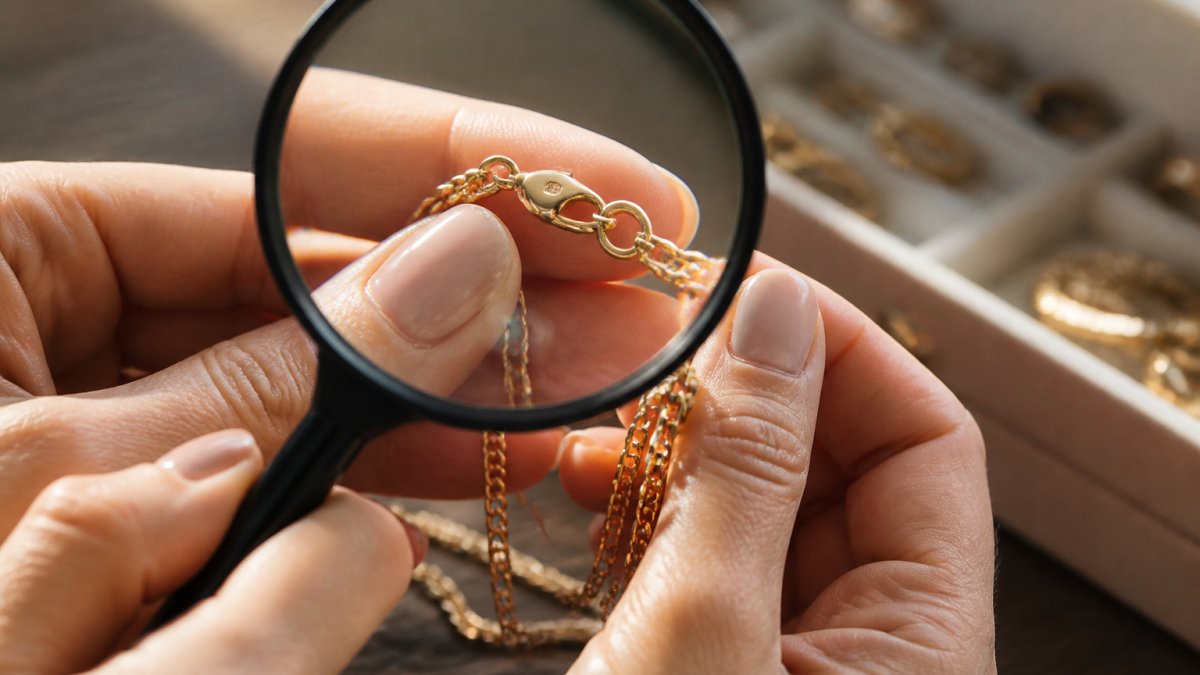
Here is where most people go wrong: they assume every gold-colored piece has a stamp. Plated and costume jewelry often has none at all, or carries a mark like "GP" for gold plated. According to the Federal Trade Commission's jewelry guidance, sellers must describe gold content accurately, which is why the stamp matters so much.
Understanding Karat Marks and Purity Numbers
Karat marks tell you how much gold is in the metal. Pure gold is 24K, but it is too soft for daily wear, so makers mix it with other metals (Rose Gold vs. Yellow Gold | Discover the Differences).
| Mark | Fineness Number | Gold Content |
|---|---|---|
| 10K | 417 | About 41.7% |
| 14K | 585 | About 58.5% |
| 18K | 750 | About 75% |
| 22K | 916 | About 91.6% |
| 24K | 999 | About 99.9% |
A 14K piece may read "14K," "14KP," or "585." Any of those is a good sign.
How to Spot Counterfeit Hallmarks
A fake stamp is easy to miss. Look closely with a magnifying glass.
- Letters look uneven, crooked, or too deep
- The mark sits on top of the surface instead of pressed in
- A high karat claim on a very light piece
- No maker's mark beside the purity stamp
Real stamps are struck into the metal, not printed on it. If a "24K" stamp appears on a hollow, featherweight chain, treat it with suspicion.
How to Test Gold at Home: What Works and What Doesn't
Home tests can offer clues, but none of them prove authenticity on their own. The real skill is knowing how much weight to give each result. Below, the common at-home checks are ranked from most to least informative, with the false positives and false negatives that trip people up.
Ranked by Reliability: What Each Test Actually Tells You
| Test | What a "pass" suggests | Common false positive | Common false negative |
|---|---|---|---|
| Magnet | Rules out a few base metals | Non-magnetic fakes (brass, copper, aluminum, stainless steel) also pass | Gold-filled or plated pieces pass because the surface is gold |
| Visual inspection | Surfaces wear patterns, fading, flaking | A fresh plating looks identical to solid gold | Heavy wear can hide a real stamp |
| Skin discoloration | Green or black residue often points to copper or brass underneath | Some people react to real gold alloys, especially lower karats | A plated piece worn briefly may not react yet |
| Water or float | Almost nothing useful | Most fakes sink too | Hollow or gemstone-set pieces may float even when gold |
| Vinegar | Mild acid does not react with gold | A plated piece can pass because the surface is gold | Acid can damage the finish before you learn anything |
A magnet that does not stick proves very little. Gold is non-magnetic, but so are many common fake metals. The magnet test only rules out a few base metals, and it says nothing about whether the surface is solid gold or a thin coating.
The water or float test sounds simple. Real gold is dense, so it should sink. The problem is that most fake pieces sink too, and hollow or gemstone-set jewelry can float even when it is real. This test rarely tells you anything useful.
Skin discoloration is another clue. A greenish residue on your skin often points to copper or brass underneath. Yet some people react to real gold alloys too, so this sign is not proof either.
Why No Single Test Is Definitive
Every at-home test shares the same flaw: it reads the surface, not the core. A gold-plated brass ring and a solid 14K ring can both be non-magnetic, both sink, and both resist a drop of vinegar. The only way to separate them is to look at construction, markings, and wear over time, or to use a professional method that reads below the surface.
Use home tests together, treat each result as one clue among several, and never rely on a single result to decide whether a piece is authentic.
Solid Gold vs. Gold Plated: Why Construction Type Matters
Construction type decides whether a piece lasts for years or fades in months. This is the distinction most guides skip, and it matters more than any single test.
- Solid gold: gold all the way through, stamped with a karat mark
- Gold filled: a thick layer of gold bonded to base metal, marked "GF"
- Gold plated: a thin gold coating over base metal, marked "GP" or "HGE"
- Vermeil: gold over sterling silver, usually marked "sterling" plus a gold purity
Plated jewelry can look identical to solid gold on day one. The difference shows up later, when the coating wears thin and the base metal shows through.
At Robyn Canady, our 14K pieces are made to hold their color and stand up to everyday wear. That is the whole point of choosing solid gold over a coating.
Triple Infinity Necklace - Now in 14K Gold →
Visual Inspection: Signs of Real Gold vs. Fake Gold
Your eyes catch things a test cannot. Start with a slow, close look under good light.
- Fading or a dull patch where the metal rubs against skin
- Dark tarnish on a piece sold as solid gold
- Color that looks too orange or too brassy
- Flaking or peeling at the edges of a plating
Real gold keeps its color. It does not flake, and it does not turn your finger green. If a piece changes color within weeks, the odds are strong that it is plated.
Professional Gold Testing: What a Jeweler Can Confirm
A jeweler can confirm what home tests cannot. Professional methods read the metal itself, not just the surface, and they give a clear answer about karat and construction. Here is what each method actually does, what it costs in rough terms, and when the trip is worth it.
The Three Main Professional Methods
- Acid testing: The tester makes a small scratch on a hidden spot, applies a drop of acid matched to a karat level, and watches the reaction. It is inexpensive, often a few dollars to around twenty dollars at a local shop, but it is destructive because it leaves a scratch. It also reads only the spot tested, so a plated piece can pass if the scratch stays in the gold layer.
- Electronic testing: A handheld device touches the metal and reads its conductivity, then displays a karat estimate. It is fast, non-destructive, and common at pawn shops and jewelers. Results can drift on hollow pieces, mixed metals, or pieces with gemstones nearby, so a trained operator matters.
- X-ray fluorescence (XRF): A scanner reads the metal's elemental composition without touching or damaging the piece. It is the most accurate of the three for surface composition and is non-destructive, which makes it the go-to for valuable or antique pieces. It reads only a shallow depth, so a thick plating can still mislead unless the operator tests multiple spots. XRF is less common at small shops and more common at appraisal labs and refineries.
When Professional Testing Is Worth It
A professional test is worth the trip when the piece is valuable, when you are buying or selling secondhand, when an insurance or appraisal value depends on the answer, or when the piece has gemstones, hollow links, or mixed metals that make home tests unreliable. For a low-value fashion piece, the cost of testing can exceed the value of the item, so a visual inspection and a magnet check may be enough.
Ask the tester which method they use and whether it is destructive before you hand over the piece. For anything you plan to insure or pass down, request the result in writing so it can travel with the piece.
The Gemological Institute of America's gem and jewelry resources explains how trained graders assess metal and stone quality. For anything valuable, this step is worth the trip.
Safe Testing Practices for Jewelry With Gemstones or Mixed Metals
Some pieces should never be tested at home. Gemstones, hollow links, and mixed metals all raise the risk of damage.
- Skip acid and vinegar on any piece with stones
- Avoid scratching a hidden spot on hollow or thin jewelry
- Do not submerge pieces with glued settings
- Test the clasp or an inside edge, never the front
For a piece you plan to pass down, ask the maker for paperwork at the time of purchase. Keep the receipt and any appraisal with it.
Conclusion: Building Confidence in Your Gold Jewelry
Knowing how to identify authentic gold jewelry comes down to a few habits: check the stamp, understand the karat, and treat home tests as clues rather than proof. When a piece really matters, let a professional confirm it.
That same care is how we build every piece at Robyn Canady. Our Triple Infinity Necklace - Now in 14K Gold pairs a 14K white gold chain with hand-hammered circles in white, yellow, and rose gold. Each 14K Amethyst Statement Ring is made entirely of 14K gold and arrives in a keepsake velvet box. With complimentary shipping on orders $100+, nearly two decades of design experience, and free returns, we make it easy to choose jewelry made to last.


Shop All and find a piece for every chapter of your story.
Frequently Asked Questions
How can you tell if gold jewelry is real at home?
Start by checking for a hallmark stamp like 14K or 585 inside the band or clasp. A magnet test helps: real gold is non-magnetic, so if the piece sticks, it contains magnetic metals. Visual inspection for tarnish, fading, or greenish residue on your skin can also signal gold-plated rather than solid gold. No single at-home test is definitive, so combine several methods and treat results as clues, not proof.
What markings indicate that gold jewelry is authentic?
Look for a karat stamp such as 10K, 14K, 18K, 22K, or 24K, often paired with a purity number like 417, 585, 750, 916, or 999. These markings and stamps should be crisp and consistent with the piece's claimed quality. A 14K stamp means 58.5% gold, while 18K means 75%. Counterfeit hallmarks exist, so verify the stamp aligns with the piece's weight, color, and overall craftsmanship before trusting it.
Does real gold stick to a magnet?
Real gold is non-magnetic, so authentic gold jewelry will not stick to a magnet. However, many fake gold pieces are also non-magnetic because they use metals like copper or aluminum. The magnet test can only rule out items that attract, not confirm authenticity. Use it alongside hallmark checks and visual inspection for a fuller picture of what you are holding.
How can you tell the difference between solid gold and gold-plated jewelry?
Solid gold is the same alloy throughout, while gold-plated jewelry has a thin gold layer over a base metal like brass or copper. Look for wear patterns: plating often fades, tarnishes, or reveals a different color metal underneath, especially on high-contact areas like clasps and edges. Solid gold keeps its color and does not develop greenish residue on skin. Stamps like GP, HGE, or RGP indicate plating.