

How to Layer Necklaces Without Tangling: 2026 Guide
Table of Contents
- Start With a Base: Selecting a Base Necklace That Anchors Your Stack
- The Two-Inch Rule: Best Necklace Lengths for Layering
- Necklace Detangler Clasp: The Simple Tool That Stops Knots
- Necklace Layering Hacks for Mixing Chain Weights, Textures, and Metal Tones
- How to Layer Necklaces Without Tangling for Every Neckline
- Skin Sensitivity, Budget Tips, and Everyday Care for Layered Necklaces
- Conclusion
- Frequently Asked Questions
Last Updated: September 21, 2026
Start With a Base: Selecting a Base Necklace That Anchors Your Stack
The secret to a layered look that stays put is starting with one anchor piece. A base layer is the necklace closest to your skin, and it does the heavy lifting for your whole stack. Choose a shorter chain, usually 16 to 18 inches, and keep it slightly heavier than the rest so your other chains rest against it instead of sliding into each other.
A few ground rules for picking your anchor:
- Pick a chain with some weight to it, like a cable or box chain
- Keep the clasp in good shape so it stays closed all day
- Choose a pendant or charm you won't mind wearing daily
- Match the base to your most common neckline first
The Two-Inch Rule: Best Necklace Lengths for Layering
The two-inch rule is the easiest way to keep layered necklaces from tangling. Space each chain about two inches apart so every piece sits on its own, which stops chains from crossing and knotting.
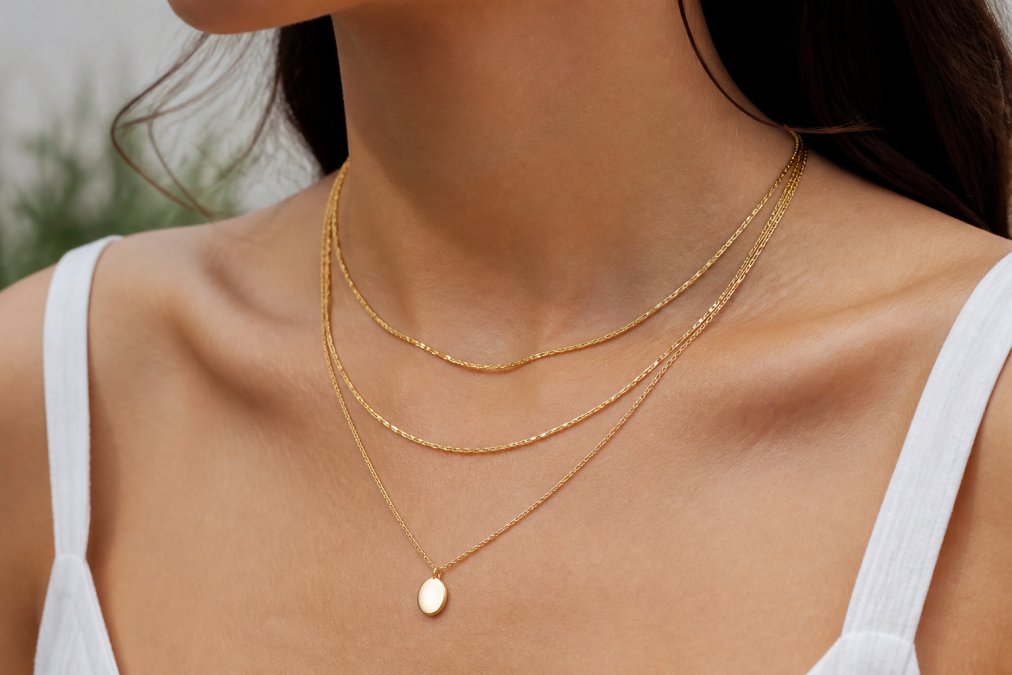
Here's how the classic lengths stack up:
| Layer | Length | Sits At | Best For |
|---|---|---|---|
| Choker | 14-16 in | Base of the neck | A bold, close fit |
| Collarbone | 16-18 in | Along the collarbone | Everyday wear |
| Princess | 18-20 in | Just below the collarbone | Pendants |
| Matinee | 20-24 in | Upper chest | Statement pieces |
Choker, Collarbone, and Statement Lengths Explained
Each length plays a different role: a choker hugs the neck as a snug base, a collarbone chain is the workhorse of most stacks, and a longer statement piece adds drama at the bottom. Keep the shortest chain dainty and let the longest carry more weight for visual balance instead of a cluttered pile.
Necklace Detangler Clasp: The Simple Tool That Stops Knots
A necklace detangler clasp holds multiple chains on one closure so they can't cross. Instead of fastening three separate clasps, you attach every chain to one clasp and close it once, keeping the chains separated from the start. This is the single biggest fix for tangling: most knots happen because separate clasps twist around each other, and one shared clasp removes the problem entirely.

Necklace Layering Hacks for Mixing Chain Weights, Textures, and Metal Tones
Mixing chain weight and texture makes a stack look curated instead of accidental. Pair a fine cable chain with a chunkier rope chain or flat box chain so the contrast in link style gives each layer its own identity.
A few layering hacks that work:
- Pair one bold chain with two dainty ones
- Repeat a metal tone at the top and bottom of the stack
- Add an extender to fine-tune length without buying new chains
- Use asymmetry on purpose, not by accident
Styling Pendants and Statement Pieces Without the Mess
Pendants are where stacks get messy: two pendants at the same length fight for space and tangle, so give each its own layer. Put your smallest pendant on the shortest chain and save the statement piece for the longest layer. If a pendant is heavy, give it a chain with more weight so it hangs straight, keeping visual balance across the look.
How to Layer Necklaces Without Tangling for Every Neckline
Your neckline changes the geometry of a stack. Chains that sit perfectly on a crew neck can bunch or fight for space on a V-neck, because the fabric edge decides where the eye lands and how much bare skin you have to work with. Treat the neckline as the starting constraint: it sets the top of your visual window, and the two-inch rule sets the spacing inside it.
V-Neck
The V creates a natural frame pointing toward your sternum. Let a pendant drop into the point of the V: start your base at 16 to 18 inches so it sits just above the V, then place a pendant chain at 20 to 22 inches so the drop lands inside the point.
Crew Neck
The fabric edge sits high and close, so long chains disappear under the shirt and short chains look cramped. Keep the stack short: a 14 to 16 inch choker plus a 16 to 18 inch collarbone chain is usually enough. Two layers read as intentional; three look like a pile.
Scoop Neck
The scoop opens a wide, shallow window across the collarbone. A mid-length collarbone chain at 16 to 18 inches fills that space without dropping below the fabric edge. If the scoop is deep, add one 20 inch layer; if shallow, stop at two chains.
Turtleneck
A turtleneck covers the neck entirely, so anything under 20 inches vanishes. Wear longer chains over the fabric: a 24 inch matinee plus a 30 inch rope or opera-length chain gives contrast against the knit. The fabric's friction reduces sliding and tangling, making this one of the easier necklines to layer on.
Off-Shoulder and Square Neck
Both necklines expose a horizontal band of skin. A choker at 14 to 16 inches plus one collarbone chain at 16 to 18 inches is enough; a third layer pushes the stack past the fabric edge and breaks the line.
Halter and High-Cut Armhole Tops
These tops draw the eye up and inward, so keep the stack minimal: one 16 to 18 inch chain with a small pendant. More than one layer competes with the top's lines.
Button-Down and Collared Shirts
Skin Sensitivity, Budget Tips, and Everyday Care for Layered Necklaces
Layering puts more metal against your skin for more hours than a single necklace would, so skin sensitivity and tarnish show up faster. Both are manageable once you understand what causes them.
Why Layered Necklaces Irritate Sensitive Skin
The reaction is usually not to gold or silver itself but to the base metal underneath a plating, most often nickel or copper. When plating wears thin, that base metal touches your skin and the reaction starts. Choose chains where the gold or silver layer is thick enough to survive daily wear.
- 14K gold filled: a thick layer of gold bonded to a brass core. The gold layer is a measurable fraction of the total weight, so it does not wear through the way plating does. This is a durable option.
- Sterling silver: solid throughout, so there is no base metal to expose. Good for most sensitive skin, though a small number of people react to the copper alloyed into sterling.
- Gold plated or gold dipped: a very thin gold layer over a base metal. Fine for occasional wear, but the plating wears through fastest at the clasp and the points where chains rub, which is exactly where layering creates friction.
Budget-Friendly Ways to Build a Stack
You do not need four new chains to start layering. A few lower-cost moves:

- Use what you own. Pull one chain from a pendant you rarely wear and pair it with a plain chain. Two existing pieces often make a better stack than one new set.
- Add extenders, not necklaces. A two-inch extender chain lets you shift an existing necklace into a new layer position for a few dollars instead of buying a new length.
- Buy one good base, then add. Start with a single 16 to 18 inch chain in a skin-friendly metal, then add lengths over time as budget allows.
- Mix price tiers deliberately. Put your best metal on the layer closest to your skin, where irritation and tarnish show first, and use plated or fashion chains on the outer layers where they touch fabric more than skin.
Cleaning and Maintaining a Layered Stack
A simple routine that keeps a stack looking new:
- Take the stack off before showering, swimming, and workouts. Chlorine and salt water are hard on both plating and sterling silver.
- Apply perfume, lotion, and hairspray first, then put the necklaces on. This is the single biggest tarnish reducer.
- Wipe each chain with a soft dry cloth after wearing. A microfiber cloth removes skin oils and sweat before they set.
- Deep-clean monthly. For sterling silver, a silver polishing cloth or a mild dish soap and warm water soak works. For gold filled and vermeil, skip abrasive polishes and use only a soft cloth and mild soap, since abrasives can wear the gold layer.
- Dry completely before storing. Moisture trapped in a jewelry box is a tarnish accelerator.
How should I store layered necklaces? Hang them on separate hooks or lay them flat in individual slots. Never toss them in a single pouch, since clasps catch on neighboring chains. For a daily stack, a wall-mounted hook rack or tiered jewelry stand keeps each layer visible and separated, making it faster to put on in the morning.
Conclusion
Layering necklaces without tangling comes down to a few habits: a solid base layer, two inches between chains, and a shared clasp that keeps everything apart. Add the right lengths for your neckline and a little care, and your stack stays tangle-free all day.
Frequently Asked Questions
What is the trick for layering necklaces without them tangling?
The two-inch rule is the most reliable trick. Space each chain two inches apart in length (for example, 16, 18, and 20 inches) so they rest at different points on your neck and chest. Pair that with a layering clasp that holds the chains together at the back, and the pieces stay separated instead of knotting. Choosing different chain weights also helps because thin chains slide against thicker ones rather than weaving together.
Can you use a necklace detangler clasp to prevent tangling?
Yes. A necklace detangler clasp attaches to your existing clasps and lets you slide multiple chains onto one closure point. This keeps the chains from twisting around each other at the back of your neck, which is where most tangles start. Robyn Canady's Layering Clasp ($28) is designed for exactly this: attach your necklaces, slide them together, and close once.
What length necklaces work best for layering?
The most versatile set is 16, 18, 20, and 24 inches. A 16-inch chain sits at the collarbone, 18 inches lands just below it, 20 inches rests on the upper chest, and 24 inches drops toward the sternum. This range covers choker, collarbone, and statement lengths, so you can adjust for different necklines. Robyn Canady's Layer it up! sets include all four lengths in matching cable chain.
Is layering necklaces still in style in 2026?
Yes. Layered necklaces remain a staple in 2026, especially curated stacks that mix chain weights and textures. The look has shifted toward intentional asymmetry and personal meaning rather than uniform sets. Mixing a dainty cable chain with a slightly thicker rope or box chain creates visual balance. Adding a pendant or charm to one layer gives the stack a focal point without making it feel cluttered.